From Streets to Systems: Rethinking Knowledge in the Age of AI
Why I think the future of academic knowledge isn't just about writing faster—but reimagining who gets to think, speak, and decide.

I didn’t expect my latest LinkedIn post to go “viral”.
I had simply fed my PhD thesis into Google’s NotebookLM—a tool that turns documents into AI-driven mind maps (amongst other features) and was stunned by what it produced. In seconds, years of digital ethnographic research, waking up at night to do online interviews with participants on the other side of the world, theoretical reflection, and intellectual labour were reframed as a navigable map of interconnected concepts. It was elegant, dynamic, and strangely… clarifying.
I shared the experience with my network. And to my surprise, it resonated. Deeply. The post amassed over 170,000 impressions (and counting), with hundreds of comments, shares, and private messages. But I think it wasn’t the tech that people were reacting to. It was the feeling—that something fundamental is shifting in how we produce, access, and trust knowledge.
The Cracks in the Academic Form
For generations, the peer-reviewed journal article has functioned as the cornerstone of academic legitimacy. It is how we claim authority, signal rigour, and gain institutional recognition. But today, that form is under pressure.
Peer review might be turning into a conversation between automated tools. Research papers are being summarised, remixed, and rewritten by large language models (LLMs). What was once a carefully curated signal of scholarly achievement is increasingly just raw material for machine processing.
This isn’t merely about automation but a broader epistemic transformation. If LLMs are already challenging how we write, we must also ask:
Why do we write the way we do?
Who are we writing for?
And does the academic article still serve that purpose?
Toward New Epistemic Interfaces
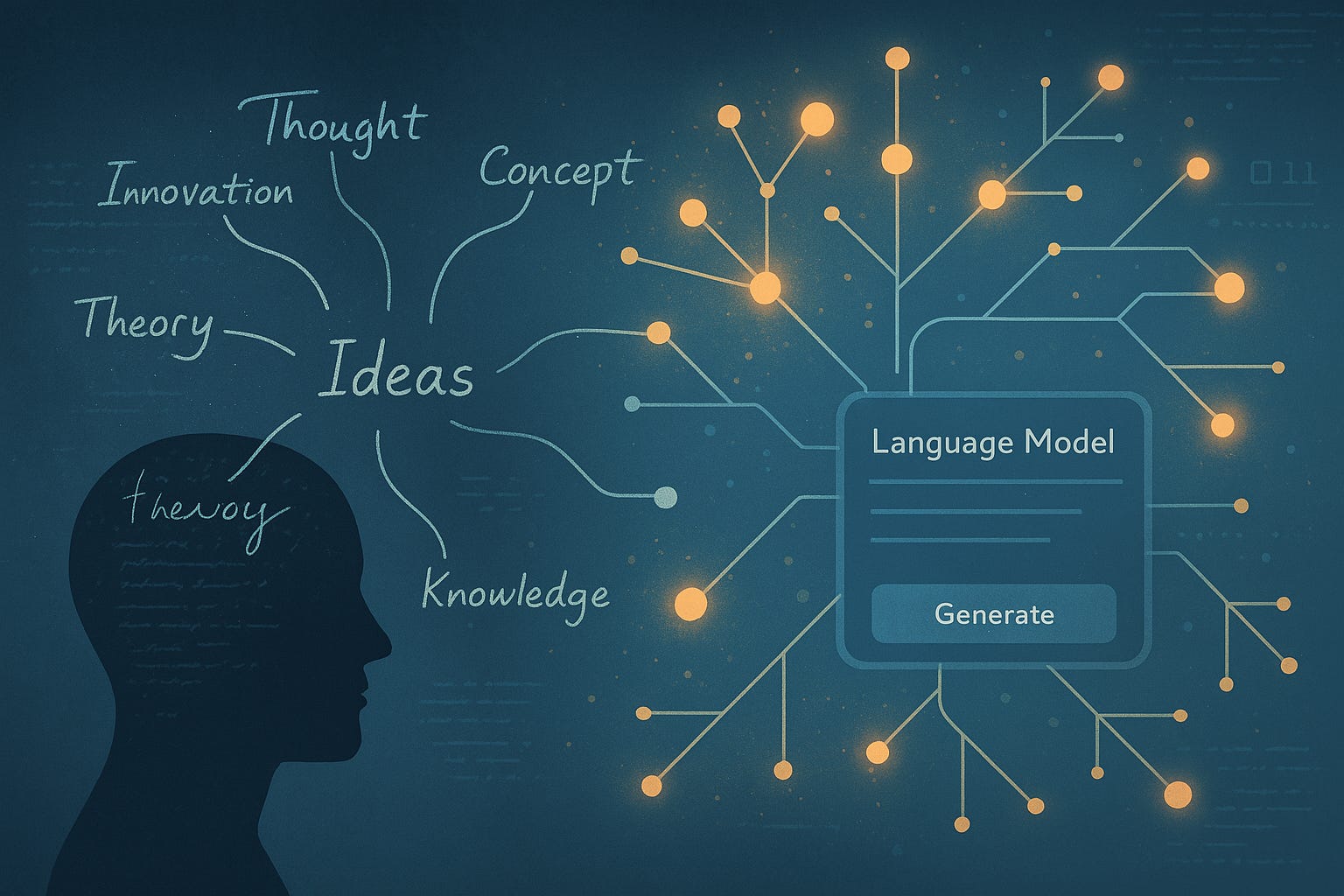
As I watched NotebookLM reconstruct my thesis into a network of concepts and prompts, it felt less like a summary and more like an invitation to think differently. It asked questions instead of giving answers. It revealed paths I hadn't consciously traced. Overall, it felt interactive, and it had all the characteristics of the iterative processes behind design thinking.
This is where I believe we’re headed—not toward the end of writing (for now) but toward new formats for structuring and navigating knowledge. Mind maps, AI-mediated dialogues, dynamic research artefacts. These aren’t gimmicks; they are epistemic interfaces for an age in which machines are no longer just tools but participants in meaning-making.
And yet, this transition is not without risk. The more we rely on black-box models to shape how knowledge is transmitted, the more we risk trading one form of authority (the academic expert) for another (the inscrutable algorithm). We may democratise access, but we also risk obscuring agency.
Civic and Street Epistemologies: A Convergence
To navigate this shift, I’ve found it helpful to draw from two conceptual traditions:
Civic epistemologies, a term from Science and Technology Studies (STS), refer to the collective processes through which societies determine what counts as legitimate knowledge in public decision-making. From courtrooms to city councils to research panels, civic epistemologies are about public reasoning at an institutional scale.
Street epistemology, by contrast, is a grassroots method of reflective dialogue, often used to examine deeply held beliefs through respectful questioning. It’s about epistemic humility, curiosity, and the ethics of persuasion.
In the age of GenAI, these two domains are beginning to overlap.
For example, when a city planner (my discipline of origin) uses an LLM to generate a public consultation summary or when a resident turns to AI to interpret zoning laws for submitting a proposal or critique a project, they’re participating in civic and street-level knowledge-making. They interact with information and negotiate epistemic legitimacy in real-time.
This is where I believe we need to focus: on designing infrastructures that support this hybrid space. Not to replace peer review or dissolve expertise but to expand the forms and forums in which people can reason together: Augmented by, but not subsumed into, AI systems.
Rethinking Our Commitments
This is not a call to abandon the academic article but to acknowledge its limits and explore its alternatives. It is a call to experiment with new epistemic forms—visual, dialogical, speculative—that better reflect how knowledge actually circulates today.
If research becomes a commodity, maybe the value lies less in the object and more in the process of inquiry. If AI becomes a co-author, maybe the point is not to emulate human thinking, but to design systems that support plural, contextual reasoning.
This moment demands more than efficiency—it demands epistemic reflexivity. Who gets to know? In what format? And how do we preserve human agency and institutional trust in an age of machine-mediated meaning?
From Streets to Systems
The post that started all this was a simple reflection on a tool. But the response revealed something more profound: a hunger to rethink how and why we write.
It revealed that we are, perhaps, in a moment of convergence—between the formal and informal, the civic and the street-level, the expert and the intuitive. A moment where the systems we build must reflect not just computational capacity but epistemic ethics and civic imagination.
Because the future of knowledge isn't just faster or smarter (or more “efficient”, for that matter)—it needs to be more distributed, dialogical, and unfinished.
And maybe, just maybe, that's precisely where it should be.
I really appreciate this reflection on the convergence of civic and street epistemologies, especially in the age of AI. As an educator focused on building a more robust knowledge that isn't so "second-hand", I see a clear connection to how we design learning in schools—it will become more about observation, interviewing sources in real-time and collect survey data from respondents at a local level.
So to your point, if knowledge is becoming more dialogical, distributed, and negotiated in real time, then classrooms must evolve too. We need to teach students not just what to think, but how to question, reason, and participate in these emerging knowledge systems with iteratively on the go.